

What Should a Personal Branding Website Include?
So, you’re building a personal brand website.
Maybe you’ve been working inside someone else’s company for years and you’re finally going out on your own. Maybe you’re consulting, coaching, speaking, creating content, or turning something you know really well into a business.
And now you need a website.
Which brings up the obvious question: what the heck are you supposed to put on it?
You can Google this and find plenty of lists telling you that you need a Home page, an About page, a Services page, a Contact page…
And yes. You probably do.
But I actually think that’s starting in the wrong place.
Before you decide what pages your personal brand website needs, figure out what someone needs to know when they get there.
Because the pages are really just containers for that information.
So let’s start there.
First: What do you actually do?
This sounds painfully obvious, but it’s one of the easiest things to overcomplicate.
Especially when you do more than one thing.
Maybe you’re a consultant AND a speaker. You have a course. You write. You advise companies. You have a podcast. You’re building a membership.
Cool.
But someone landing on your website for the first time doesn’t know how all of those pieces fit together yet.
You do.
You’ve been living inside this thing.
They just got here.
So before you worry about explaining every offer, zoom out.
What’s the big picture of what you do?
If someone asked you at a party, “So, what do you do?” what would you say?
Not your clever tagline.
Not your mission statement.
Just…what do you do?
That answer needs to be VERY easy to find on your website.
Who is it for?
You don’t need to do a 23-page ideal client exercise for this.
You just need to make it clear enough that the right person can land on your website and think:
Oh, this is for me.
Sometimes that means literally saying who you work with.
Sometimes the problems you talk about make it obvious.
Sometimes it’s a combination of the two.
But there should be enough context that I’m not sitting there wondering whether you work with giant corporations, brand-new business owners, creative teams, women in leadership, local restaurants, or professional dog walkers.
And you don’t necessarily have to niche yourself into one microscopic little box to accomplish that.
You just need to help people understand where they fit.
Why should I choose you?
Okay, now I understand what you do and I think it might be for me.
My next question is probably some version of:
Why you?
This is where your experience matters.
Maybe you spent 15 years doing this inside a Fortune 500 company.
Maybe you’ve helped 200 clients.
Maybe you developed a particular process because you kept seeing the same problem over and over.
Maybe you have some really good work to show.
Maybe your clients have some really good things to say about you.
Maybe you’ve been featured somewhere, written a book, earned credentials, taught thousands of people, built something successful yourself.
Whatever your proof is, use it.
And please don’t save all of it for one lonely Testimonials page nobody is going to click on.
Put the proof near the thing it’s proving.
If you’re talking about a service, show me what happened for someone who used it.
If you’re telling me you’ve been doing this for 15 years, tell me where.
If you make beautiful things, show me the beautiful things.
Your website shouldn’t just tell people what you can do. Give them a reason to believe you.
How can someone actually work with you?
This is another one that sounds obvious until you start looking at websites and realize how many people make you WORK to figure out how to give them money. 😂
Tell me what you sell.
If you have one primary offer, great. Make that sucker easy to find.
If you have several, give them some hierarchy.
Maybe there are three different ways to work with you depending on what someone needs.
Maybe consulting is your main thing, but you also speak at events.
Maybe you have a done-for-you service and a course for people who want to do it themselves.
Your website doesn’t need to pretend you only do one thing if that isn’t true.
It just needs to organize those things in a way another human can understand.
I think that distinction matters a lot for personal brands because they tend to grow.
You start doing one thing, then another opportunity makes sense, then you create something, then people start asking you to speak, and suddenly the business doesn’t fit into one neat little box anymore.
That’s okay.
The website just needs to make sense of it.
Who are you?
Yes, now we get to you.
Because this is a personal brand.
I don’t think your About page needs to be your résumé copied and pasted onto a website.
And I don’t think it needs to be your entire life story either.
Give me the pieces that help me understand why you’re the person doing this work. And do it all through a “how does this benefit the client?” kinda lens.
You spent 15 years leading marketing teams? Great. How does that experience make you better at helping me?
You started this business because you struggled with the exact same thing your clients struggle with now? Tell me what you learned because of it.
You have a very particular way of approaching your work? Tell me why that approach matters to the person hiring you.
It’s still your story. We’re just being intentional about which parts of it belong here.
And then, yes, let me know a little about the actual human too.
People hire people. Especially in a personal brand business.
You don’t have to turn your website into your diary, but you also don’t have to scrub every ounce of yourself out of it in an attempt to look “professional.”
Your About page is about you – but it’s still for them.
What do you want someone to do next?
This is the part I think we forget when we get really focused on what a website should have.
What is it supposed to do?
If the right person lands on your website today, what would you ideally like them to do next?
Book a call?
Fill out an inquiry form?
Buy something?
Invite you to speak?
Join your email list?
Your answer might change depending on the person or page, but there should be a path.
I like to start with that end goal and work backward.
If I want someone to book a call, what do they need to know before they’re comfortable doing that?
What questions do they have?
What might stop them?
What would help them feel ready?
Answer those things.
Then make the next step obvious.
That’s website strategy.
Okay, so what pages does a personal branding website actually need?
NOW we can talk pages.
Because once we know what information the website needs to communicate, deciding where it belongs gets a whole lot easier.
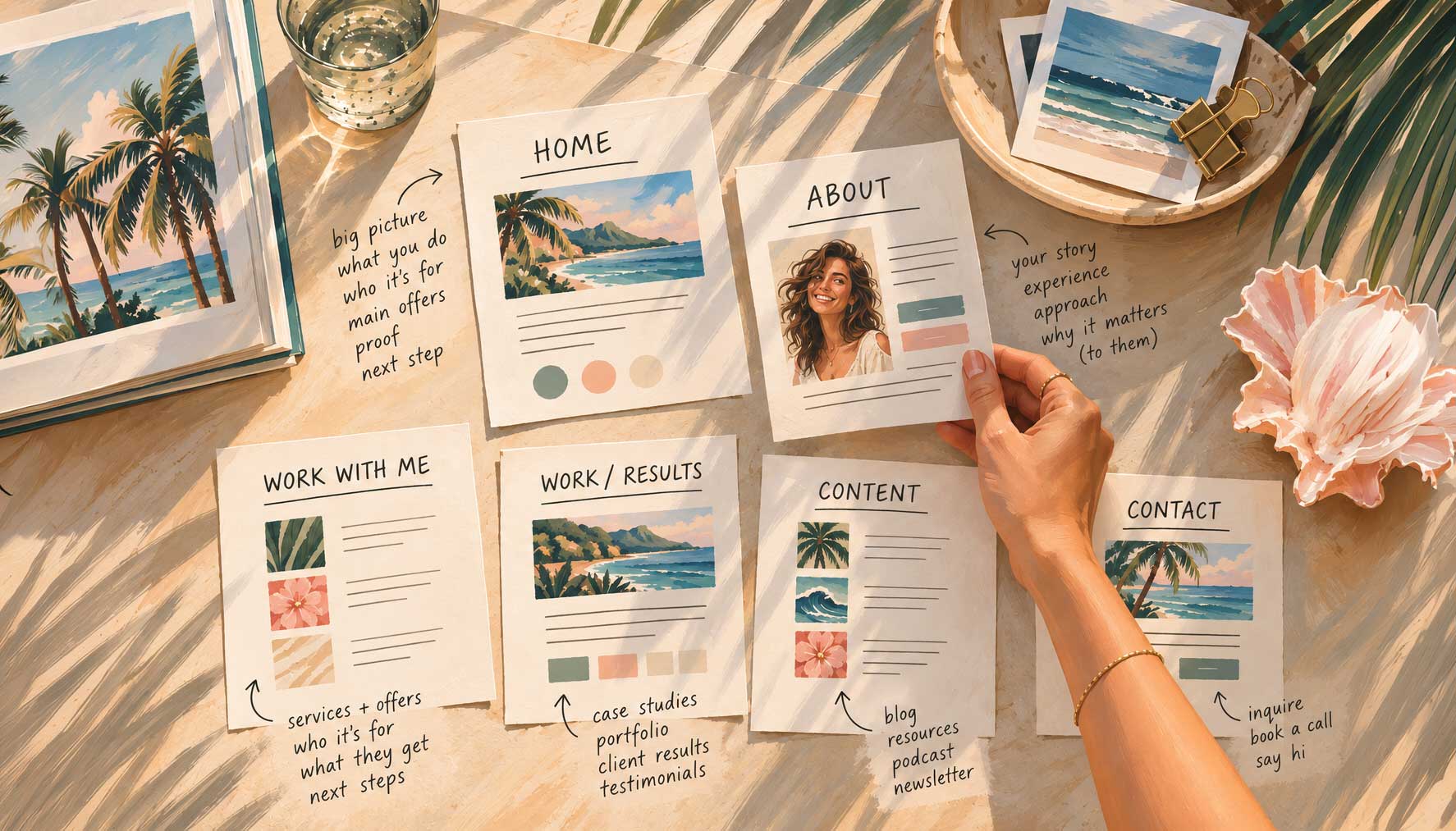
For most personal brands, I’d start here:
Home
This is the big picture.
What you do. Who it’s for. A quick introduction to you. The main ways someone can work with you. Some proof that you know what you’re doing. And a clear place to go next.
Your homepage doesn’t need to say everything.
It needs to help someone understand where they are and where they should go from there.
About
This is where you can go deeper into your story, experience, values, approach, why you do this work…and why that matters to them.
For a personal brand, I think this page matters.
Someone isn’t just researching a company. They’re researching you.
Give them enough to feel like they know who they’re considering working with.
Work With Me / Services
Make the ways someone can hire you very clear.
If you have multiple offers, this page can give an overview and direct people to individual pages to learn more.
If you only have one simple offer, you may not need layers and layers of sales pages.
Build what your business actually needs.
Individual offer pages
These are useful when an offer needs more explaining.
Who is it for? What does it include? What problem does it solve? What does working together look like? What have other people experienced? How do I get started?
If your Work With Me page can answer all of that without becoming a novel, great.
You don’t get bonus points for having more pages.
Work / Results / Case Studies
This one depends on what you do.
A designer needs to show work.
A consultant may benefit more from case studies.
A speaker might show past events, topics, clips, and testimonials.
The format can change. The purpose is the same:
Show me that you can do the thing you’re telling me you can do.
Content
Blog, podcast, videos, resources, newsletter – whatever makes sense for how you show up.
This isn’t required just because you have a personal brand.
But if part of your business depends on people discovering your ideas and expertise, give those ideas somewhere to live.
It also gives someone who isn’t ready to hire you yet a way to stick around and get to know your work.
Contact
Please just make it easy. 😂
Tell people how to contact you, what they can contact you about, and what happens next.
Done.
Do you actually need all of those pages?
Nope.
If you’re leaving your corporate job and starting a consulting business with one service, you may even be able to get away with a simple single-page website.
That could be enough.
If you’ve been building your personal brand for ten years and now you consult, speak, write, sell courses, host a podcast, and have three different audiences?
You probably need more structure.
Your website should be as complicated as your business requires. Not as complicated as you can make it.
And I think that’s why starting with a generic list of pages can send you in the wrong direction.
Start with the person landing on your website.
What do they need to know?
What do they need to see?
What questions do they have?
What do you want them to do next?
Then build the website that answers those questions.
And once you have the structure figured out, then you get to make the whole thing feel like you.
Because yes, that’s important too.
I actually wrote an entire article about how to make your personal brand feel like you – so I’d head there next if you’ve got the bones but your brand still feels a little…generic.
Structure first.
Then make it yours.
Your brand deserves a style that feels like you— magnetic, and unforgettable. Take our quick Brand Style Quiz to discover the perfect aesthetic for your business.
Your brand Identity Starts with Style. Discover yours!

Leave a Reply Cancel reply
Privacy Policy
Terms and Conditions
Offering simple branding tools and customizable website templates for purpose-driven entrepreneurs ready to craft a memorable digital presence—with ease.


Digital Downloads
©2025 Beachy Keen Creative. All rights reserved.
Blog

Your information is 100% secure and we promise not to spam you.
Crafting a professional, well-balanced color palette shouldn’t be gatekept. The Color Palette Guide reveals the secrets to creating a cohesive, visually stunning palette that speaks to your audience and reflects your brand’s personality.
Unlock the color secrets that top brand designers don't want you to know
Branding for all!


Take the FREE Signature Style Quiz, learn the core identity of your business, and make it a BRAND with tools and resources to put your style into action.
Turn your Business into a Brand with a your own Signature Style
FREE Brand Style QUIZ!!


